

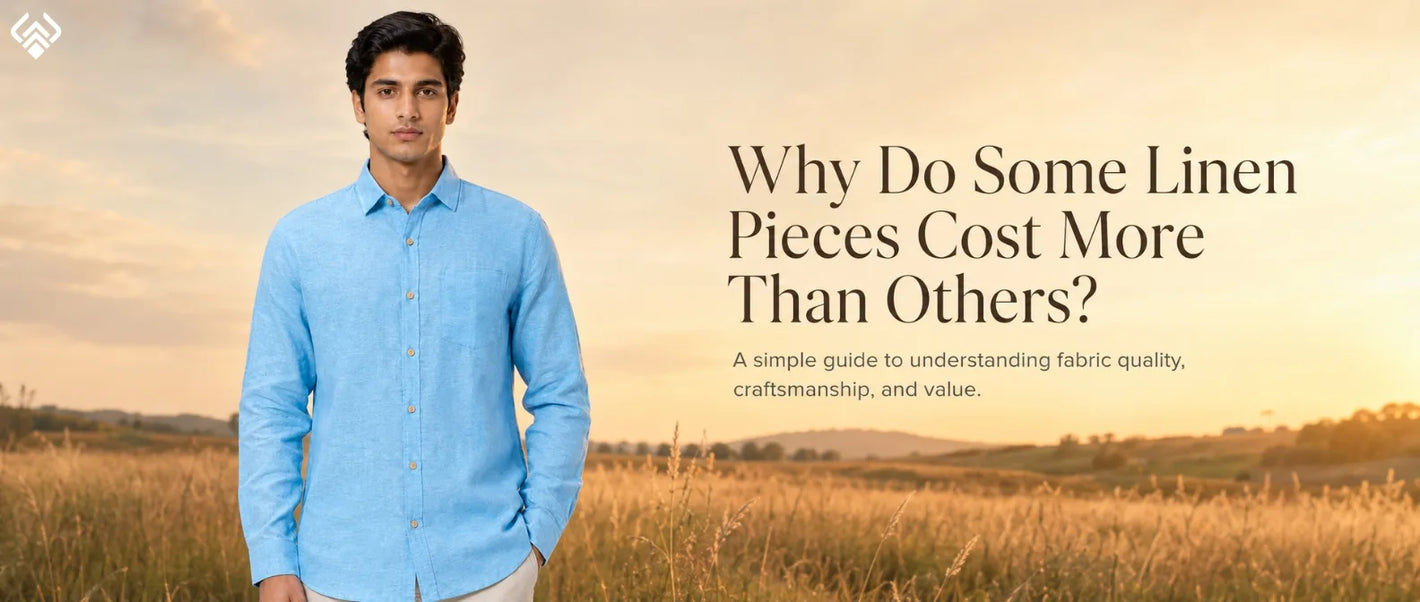
Some linen pieces cost more than others because of differences in flax fiber quality, weave density, where the linen is grown and processed, and how much finishing work goes into the final garment. A ₹1,500 linen shirt and a ₹6,000 linen shirt can look similar on a hanger, but they're often made from entirely different grades of fiber, woven at different densities, and finished with completely different levels of care. Price in linen isn't arbitrary; it almost always maps to something measurable in the fabric itself.
That doesn't mean the most expensive linen is automatically the best choice for everyone, or that budget linen is always a bad buy. It just means understanding what actually drives the cost helps you figure out what you're paying for, and whether it's worth it for how you plan to wear the piece.
What Determines the Base Cost of Linen Fiber
Flax fiber quality starts with the plant itself, and not all flax is grown or harvested the same way. Long-staple flax fiber, which comes from carefully retted and combed flax plants, produces a smoother, stronger, more consistent thread than short-staple fiber pulled from lower-grade processing. Long-staple fiber costs significantly more to produce because it requires more careful harvesting and processing, but it results in linen that feels smoother against the skin and resists pilling far better over years of wear.
Where the flax is grown also affects cost. European flax, particularly from regions in France, Belgium, and the Netherlands, is widely regarded as producing some of the highest-quality fiber in the world due to favorable growing conditions and generations of refined processing techniques. Flax grown and processed in these regions typically costs more than flax from lower-cost growing regions, and that cost difference carries through directly into the price of the finished garment.
How Weave Density and GSM Affect Linen Pricing
Weave density, measured in GSM (grams per square meter), is one of the clearest technical factors separating cheap linen from premium linen. A tightly woven, higher-density linen in the 180 to 220 GSM range takes more raw fiber and more precise weaving to produce than a loosely woven, lightweight linen closer to 120 GSM. That extra fiber and manufacturing precision shows up directly in the price, and it also shows up in how the finished garment performs, since denser weaves resist thinning, fraying, and see-through wear far longer than looser ones.
This is why two shirts advertised as "100% linen" can feel completely different in hand and cost noticeably different amounts. A loosely woven, low-GSM linen shirt might be cheaper and feel airier right off the shelf, but it's also more likely to develop snags, thin patches, or a limp, tired look within the first year of regular wear. A denser weave costs more upfront but tends to reward that cost with a garment that holds its shape and structure for years rather than months.
Casual Shirt


Does More Expensive Linen Actually Perform Better?
In most cases, yes, though the relationship isn't perfectly linear once you get into extremely high price brackets. Up to a certain point, more expensive linen genuinely correlates with longer-staple fiber, denser weaves, and more careful finishing, all of which translate into a garment that softens more gracefully and lasts longer under repeated washing. Anyone who has worn both a budget linen shirt and a well-made one side by side for a full year usually notices the difference clearly: the cheaper piece thins out and loses shape faster, while the better-made one softens without losing structural integrity.
Beyond a certain price point, though, additional cost often reflects brand markup, packaging, or limited-run exclusivity rather than meaningfully better fiber or construction. The sweet spot for most buyers sits in the mid-range, where you're paying for genuine fiber quality and weave density without paying extra purely for a luxury label.
Why Finishing and Dyeing Add to Linen's Price
Finishing is one of the most overlooked cost factors in linen pricing, and it makes a real difference in how a garment looks and feels over time. Pre-washing or "stone-washing" linen before sale, which softens the fiber and reduces the shrinkage a buyer will experience at home, adds a manufacturing step that increases cost but also improves the wearing experience from day one. Garments skipping this step are often cheaper, but they arrive stiffer and require the buyer to go through several wash cycles before the linen reaches a comfortable, broken-in feel.
Dyeing quality matters just as much. Natural or low-impact dyes tend to cost more than cheap synthetic dyes, but they also hold their color more evenly through repeated washing and tend to be gentler on the fiber itself, preserving strength that harsh dyeing chemicals can otherwise degrade. A linen piece that fades unevenly or bleeds color after a few washes is often a sign of lower-quality dyeing rather than a fault with the linen fiber itself.
How Origin and Manufacturing Process Influence Cost
Where a linen garment is manufactured, not just where the flax is grown, adds another layer to the pricing picture. Small-batch or artisanal linen production, common in regions with long-standing linen weaving traditions, typically costs more than large-scale industrial manufacturing because it involves more manual quality control and slower production timelines. This isn't purely about tradition for its own sake; slower, more hands-on production tends to catch weaving flaws and inconsistencies that faster industrial processes can miss.
Labor and ethical sourcing standards also factor into cost. Linen produced under fair labor practices and transparent sourcing generally costs more than linen produced through opaque, lower-cost supply chains, and buyers increasingly factor this into what they're willing to pay for a garment beyond just the fabric's physical qualities. [Link: linen-care-guide] touches on how to spot well-finished linen at the point of purchase, which is a useful skill regardless of what price bracket you're shopping in.
Linen Pricing Compared Across Fabric Types
Here's a factual look at how linen's typical price range and quality factors compare to cotton, polyester, and silk, covering what usually drives cost differences and where each fabric tends to land on the value spectrum.
|
Fabric |
Typical Price Range |
Main Cost Driver |
Durability at Price Point |
Care Level |
Best Use Case |
|
Linen |
Mid to High |
Fiber length, weave density, origin |
Very High (improves with age) |
Moderate |
Long-term daily wear, investment pieces |
|
Cotton |
Low to Mid |
Thread count, finishing |
Moderate |
Low to Moderate |
Everyday basics, replaceable wardrobe staples |
|
Polyester |
Very Low |
Manufacturing scale, synthetic base cost |
High (resists tearing, wears visibly) |
Very Low |
Budget clothing, activewear |
|
Silk |
High |
Fiber rarity, hand-processing |
Low to Moderate |
High (often dry clean only) |
Formalwear, occasion pieces |
The clearest pattern here is that linen sits in a middle tier that rewards a moderate upfront investment with genuinely long-term durability, unlike polyester, which stays cheap but degrades in appearance, or silk, which costs more but requires far more delicate handling to last.
Premium Linen


Frequently Asked Questions
Is expensive linen worth it, or is cheap linen just as good?
Expensive linen is generally worth it up to a reasonable mid-range price point, since that price typically reflects genuine differences in fiber length, weave density, and finishing that affect how the garment performs over years of wear. Cheap linen, especially anything significantly underpriced compared to the market average, often uses shorter fiber and looser weaves that thin out and lose shape within a year or two. That said, the most expensive linen on the market isn't always proportionally better, since very high prices sometimes reflect brand positioning more than fiber quality.
How can you tell if linen is high quality before buying it?
Checking the weave density by holding the fabric up to light is one of the most reliable at-a-glance tests, since a tightly woven, high-quality linen lets through noticeably less light than a loose, lower-grade weave. Feeling for a smooth, consistent texture rather than an uneven, slightly rough hand-feel is another good indicator, since long-staple fiber produces a more uniform thread than short-staple fiber. Reading the fabric composition label for details like GSM weight or country of flax origin, when available, gives you concrete information rather than relying on price alone.
Does linen from certain countries cost more for a good reason?
Yes, linen from regions with established flax-growing traditions, particularly parts of Europe, generally costs more because the growing conditions and generations of refined processing produce measurably stronger, smoother fiber. This isn't purely reputation; the climate and soil conditions in these regions genuinely affect fiber quality in ways that show up in the finished fabric's strength and feel. That said, well-processed flax from other regions can still produce solid, durable linen, so origin is a helpful indicator rather than the only factor worth considering.
Why does handwoven linen cost so much more than machine-made linen?
Handwoven linen costs more primarily because of the labor time involved, since a skilled weaver working by hand produces fabric far more slowly than an industrial loom, but that slower process also allows for more careful quality control throughout production. Handwoven linen often has subtle texture variations that some buyers specifically seek out as a mark of authenticity, while machine-made linen tends to be more uniform and consistent. Both can be high quality, but handwoven pieces typically justify their higher price through craftsmanship and reduced production volume rather than superior fiber alone.
Can two shirts made from the same linen fabric have different prices?
Yes, this happens more often than buyers expect, and the price difference usually comes down to construction details like stitching quality, buttons, lining, and brand overhead rather than the fabric itself. A shirt with reinforced seams, quality buttons, and careful pattern-cutting costs more to produce than one made from the same fabric but assembled with minimal finishing work. This is why comparing fabric composition alone isn't enough when evaluating whether a price difference is justified; construction quality plays an equally important role.
Does higher-priced linen wrinkle less than cheaper linen?
Not necessarily, since wrinkling is primarily a property of the flax fiber itself rather than something that price fully controls, meaning even premium linen wrinkles noticeably during regular wear. What higher-priced linen usually offers instead is a more refined wrinkle pattern, with softer, more rounded creases rather than the sharp, papery wrinkles common in cheaper, thinner weaves. If wrinkle resistance specifically is a priority, look for a linen blend with a small percentage of cotton or elastane rather than assuming a higher price tag alone will solve the issue.
Understanding what actually drives linen pricing makes it a lot easier to shop with confidence instead of guessing based on a number on a tag. Fiber length, weave density, and finishing quality are the real levers behind the price difference between a shirt that lasts a season and one that holds up for a decade of regular wear. If you're deciding where to invest in your wardrobe, it's worth prioritizing pieces built from properly sourced, well-woven linen over ones that simply carry the lowest price. [Link: linen-shirts] is a good place to see what that kind of craftsmanship actually looks and feels like once you compare it side by side with a budget alternative

