

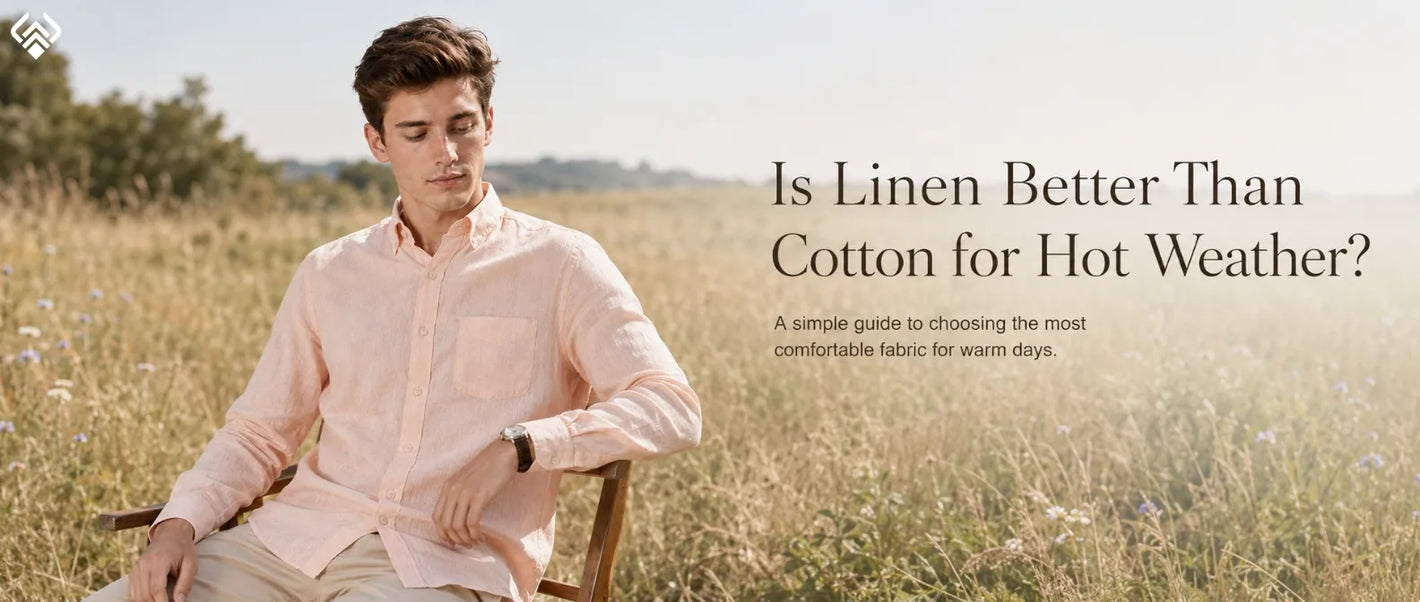
Linen is generally better than cotton for hot weather because its fiber structure allows more airflow and faster moisture evaporation, keeping the body cooler for longer stretches of time. Cotton is soft and absorbent, but it holds onto moisture rather than releasing it quickly, which can leave fabric feeling damp and heavy once you start sweating. Linen's open, slightly stiff weave does the opposite: it pulls moisture away from the skin and lets it evaporate almost as fast as it forms.
That doesn't mean cotton is a bad choice or that linen wins in every single scenario. The real answer depends on humidity levels, how much you move during the day, and what you're using the garment for. Once you understand how each fiber actually behaves in the heat, the choice becomes a lot clearer.
Why Linen Feels Cooler Than Cotton in Direct Heat
Linen comes from the flax plant, and its fibers are hollow and slightly larger in diameter than cotton fibers, which allows more air to move through the fabric itself. This structure is what textile experts call high air permeability, and it's the main reason a linen shirt feels breezy even when the sun is directly overhead. Cotton fibers are more tightly packed and rounder, which makes cotton soft against the skin but less effective at letting hot air pass through the weave.
There's also a difference in how fast each fabric dries. Linen releases moisture up to 20% faster than cotton because its fiber structure doesn't trap water molecules the way cotton's does. In practice, this means a linen shirt worn during a humid afternoon walk will feel noticeably less clingy and damp by the end of the walk than a cotton shirt worn under the same conditions. Anyone who's worn both fabrics through a full Indian summer knows the difference isn't subtle — it shows up within the first hour outdoors.
Does Linen Absorb Sweat Better Than Cotton
Cotton actually absorbs more moisture per fiber than linen does, holding onto roughly 20-25% of its own weight in water compared to linen's slightly lower absorbency. This sounds like it should make cotton better for sweat, but the opposite plays out in real wear. Cotton holds moisture close to the skin, which keeps the fabric feeling wet and heavy, while linen wicks moisture to the fabric's surface and lets it evaporate into the air instead of sitting against your body.
Luxe Choices


This is why cotton t-shirts often feel damp and clingy hours into a hot day, while a linen shirt worn under identical conditions tends to feel dry to the touch even after visible sweating. If you've ever noticed sweat rings on a cotton shirt that never seem to fully disappear, that's the fiber holding onto moisture rather than releasing it. Linen simply moves moisture through and out faster, which matters more for comfort than raw absorbency numbers suggest.
How Weave and Weight Affect Performance
Not all linen and not all cotton perform the same way, and weight matters as much as fiber type. A lightweight linen weave around 170 to 200 GSM (grams per square meter) is ideal for peak summer heat, offering maximum airflow without sacrificing structure. Heavier linen weaves, closer to 250 GSM, still breathe well but suit cooler evenings or transitional seasons better than the hottest part of the day.
Cotton follows a similar logic. A loosely woven, lightweight cotton like voile or lawn performs reasonably well in heat, while a denser cotton weave like twill or canvas traps heat and feels stifling in direct sun. The takeaway here is that weave density often matters as much as fiber choice, though linen's advantage holds even when you compare similar weights of each fabric side by side.
Linen vs Cotton in Humid Climates
Humidity changes the equation slightly, and this is where linen pulls further ahead of cotton. In high-humidity environments, air is already saturated with moisture, which slows down evaporation for any fabric. Linen's faster drying time and open weave still give it an edge here because it doesn't need as much airflow to shed moisture as cotton does. Cotton, on the other hand, struggles more in humidity because it's already inclined to hold onto water, and a humid environment gives that trapped moisture nowhere to go.
Anyone who's traveled through a coastal or monsoon climate in both fabrics notices this quickly. A linen shirt worn through a humid afternoon dries out considerably faster once you step into shade or air conditioning, while a cotton shirt worn through the same conditions can stay damp for much longer. This is one of the clearest real-world differences between the two fabrics, and it's a major reason linen has been the go-to fabric for hot, humid regions for centuries.
Comfort, Softness, and Skin Feel: Where Cotton Still Wins
Linen isn't superior in every category, and softness is where cotton has a genuine advantage, especially with new or unwashed linen. Cotton fibers are naturally softer and more flexible straight off the shelf, which is why cotton is often the go-to choice for baby clothes, undergarments, and everyday basics that need to feel gentle against the skin immediately. Linen, by comparison, starts out somewhat stiff and crisp, and it takes several washes before it develops the soft, broken-in hand-feel that longtime linen wearers love.
This is an honest trade-off worth knowing before you buy. If you want immediate softness with no break-in period, cotton delivers that from the first wear. If you're comfortable investing a few washes into a fabric that gets progressively better with age, linen eventually surpasses cotton in both comfort and durability, since flax fibers are stronger than cotton fibers and hold up to years of washing without breaking down. [Link: linen-care-guide] walks through exactly how to wash linen so it softens properly instead of wearing out unevenly.
Fabric Comparison for Hot Weather: Linen, Cotton, and Other Common Fibers
Here's a factual breakdown of how linen stacks up against cotton and a few other fabrics people commonly consider for hot-weather clothing. This comparison covers breathability, moisture handling, durability, and the situations where each fabric performs best, so you can match the fabric to your climate and lifestyle.
Casual Shirt


|
Fabric |
Breathability |
Moisture-Wicking |
Durability |
Care Level |
Best Use Case |
|
Linen |
Very High |
High (fast-drying) |
Very High (improves with age) |
Moderate (cold wash, low-heat dry) |
Hot, humid climates, all-day summer wear |
|
Cotton |
High |
Moderate (absorbs, dries slower) |
Moderate to High |
Low to Moderate |
Everyday basics, mild heat, casualwear |
|
Polyester |
Low |
Low (traps heat, doesn't breathe) |
High |
Very Low |
Activewear where stretch matters more than heat |
|
Silk |
Moderate |
Low |
Low to Moderate (delicate) |
High (often dry clean only) |
Warm evenings, light formalwear |
|
Rayon/Viscose |
Moderate to High |
Moderate |
Low to Moderate |
Moderate to High |
Warm-weather drape pieces, flowy dresses |
The pattern that stands out here is that linen and cotton both outperform synthetic fabrics like polyester in the heat, but linen consistently edges out cotton on breathability, moisture release, and long-term durability. Cotton still holds its ground on immediate softness and lower care requirements, which is why it remains a practical everyday choice even in warm weather.
Frequently Asked Questions
Is 100% linen too hot to wear in extreme heat?
No, 100% linen is one of the best-performing fabrics specifically because it's designed for extreme heat, thanks to its open weave and fast-drying fiber structure. The confusion often comes from wearing linen blends with polyester or heavier weaves closer to 300 GSM, which trap more heat than a pure, lightweight linen would. For genuinely hot conditions, a pure linen shirt around 170 to 200 GSM stays noticeably cooler than most cotton alternatives.
Does linen shrink more than cotton after washing?
Linen can shrink slightly more than cotton on the first two or three washes, typically around 3-5%, before the fiber settles into a stable size. Cotton also shrinks, usually in a similar range, but linen's shrinkage tends to happen faster and then stop, while cotton can continue shrinking gradually with repeated hot washes. Washing linen in cold water and avoiding high-heat drying from the very first wash minimizes this shrinkage significantly.
Which fabric is better for sweating a lot in summer, linen or cotton?
Linen is generally the better choice for heavy sweating because it releases moisture faster than cotton, preventing that damp, clingy feeling that builds up over a long hot day. Cotton absorbs more moisture initially, which can feel comfortable at first, but it holds onto that moisture and takes longer to dry out once you're sweating consistently. For anyone who sweats heavily during summer activity, a lightweight linen shirt tends to stay more comfortable hour after hour than an equivalent cotton one.
Is linen good for daily wear or only occasional summer outfits?
Linen works well for daily wear once you get used to its natural wrinkle and slightly relaxed structure, and many people who switch to linen full-time in summer never go back to cotton for hot-weather basics. The main adjustment is mental rather than practical: linen isn't going to look pressed and flat the way cotton can, and accepting that texture is part of making it a daily fabric rather than an occasional one. After a few months of regular wear, linen becomes noticeably softer and more comfortable, which makes daily wear easier to stick with.
Does linen get softer over time compared to cotton?
Yes, linen undergoes a more dramatic softening transformation over time than cotton does, since flax fibers relax and the weave loosens with every wash cycle. Cotton starts soft and stays relatively consistent through its lifespan, while linen starts stiffer and gradually becomes softer, often surpassing cotton in hand-feel after a year or two of regular washing and wear. This is one of the more rewarding aspects of owning good linen: it genuinely improves the longer you keep it in rotation.
Can you wear linen and cotton together in the same outfit?
Yes, mixing linen and cotton in the same outfit is common and works well, especially when you want the breathability of linen on top with the softness of cotton underneath, or vice versa. A linen shirt over a cotton undershirt is a practical combination for hot weather since it balances skin comfort with airflow. There's no fabric conflict between the two, and many warm-climate wardrobes rely on this kind of layering rather than choosing one fiber exclusively.
Choosing between linen and cotton really comes down to how much you value breathability and long-term durability versus immediate softness and lower maintenance. If your summers run hot and humid, linen's ability to move moisture and air through the fabric makes a real difference by the middle of the day, and that difference only grows the more you wear it. What matters most, whichever fabric you land on, is starting with a well-constructed weave rather than a thin or blended one that won't hold up to repeated summer wear. is worth a look if you want to see what a properly woven, breathable linen piece actually feels like once it's broken in.

